For years, the cybersecurity industry has relentlessly focused on securing application dependencies. We’ve built extensive tooling to scan npm, PyPI, and RubyGems, and we’ve normalized the use of SBOMs to track exactly what goes into our compiled binaries. But as our defenses in the application layer have matured, attackers have inevitably shifted their focus to a softer, less-scrutinized target: the infrastructure itself.
Welcome to the era of "Poisoned Blueprints."
In 2026, practically all cloud environments are provisioned via Infrastructure-as-Code (IaC) tools like Terraform, OpenTofu, and Pulumi. To save time, developers routinely pull pre-built modules from public registries to deploy complex architectures like Kubernetes clusters, serverless workloads, or database clusters. However, this reliance on third-party IaC modules has introduced a massive, often unchecked supply chain vulnerability.
The Anatomy of an IaC Supply Chain Attack
An IaC supply chain attack occurs when a malicious actor compromises or publishes a rogue module to a public registry. Because these modules are essentially code that dictates cloud API interactions, the payload isn't a traditional virus or malware. Instead, it is a configuration payload.
When a developer includes the poisoned module in their pipeline, the IaC tool executes the blueprint. While the module successfully provisions the requested database or cluster—ensuring the developer doesn't notice anything is broken—it simultaneously provisions shadow infrastructure.
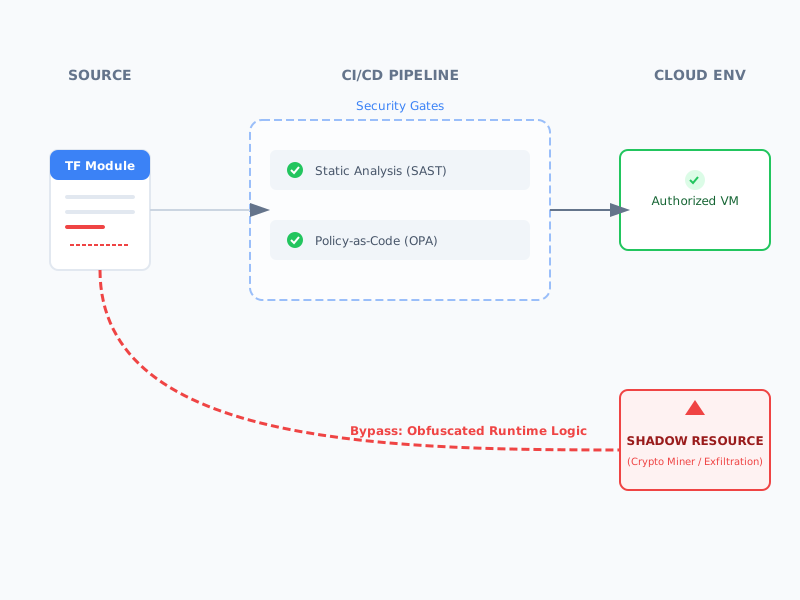 Malicious IaC modules can circumvent standard security gates through obfuscation, leading to the creation of unmanaged and potentially dangerous shadow infrastructure.
Common payloads hidden within malicious IaC modules include:
- Shadow IAM Roles: Creating hidden, highly privileged cross-account roles that allow attackers persistent access to the AWS or GCP environment.
- Data Exfiltration Routes: Silently modifying Security Groups or VPC routing tables to mirror traffic or allow outbound connections to attacker-controlled IPs.
- Malicious Provisioners: Utilizing features like Terraform's
local-execto run arbitrary shell scripts directly on the CI/CD runner executing the plan, effectively stealing pipeline secrets and cloud credentials.
Why IaC is the Perfect Hiding Place
Malicious IaC modules are incredibly difficult to detect for a few reasons. First, the code is often highly abstracted. A single root module might call a dozen nested sub-modules, burying the malicious resource definitions deep within the dependency tree.
Second, traditional application security tools (SAST/DAST) are blind to infrastructure configurations. While specialized IaC scanners exist, attackers are increasingly using complex dynamic variables and obfuscated string interpolations that only resolve at runtime. If security teams are only scanning the static code and not the generated execution plan, the malicious resources slip right through.
Defending Your Cloud Blueprints
To protect your software supply chain from poisoned blueprints, security and platform engineering teams must implement strict guardrails around how infrastructure is provisioned:
1. Treat IaC Modules Like Software Dependencies
Your IaC modules require the same level of scrutiny as your application libraries. Never pull modules blindly using dynamic version tags (e.g., ~> 2.0). Pin all third-party modules to specific, verified cryptographic hashes or strictly vetted versions.
2. Enforce Private Registries Disable the ability for production CI/CD pipelines to pull directly from public IaC registries. Instead, utilize a private, internal registry. All external modules should be mirrored internally only after undergoing a rigorous security review.
3. Scan the Plan, Not Just the Code Static analysis of IaC code is no longer sufficient. Security checks must be integrated into the pipeline after the plan is generated but before it is applied. By evaluating the actual execution plan (e.g., the JSON output of an IaC plan phase), you can detect anomalous resource creation—like an unexpected IAM role—regardless of how heavily the source code was obfuscated.
4. Restrict CI/CD Runner Privileges
If an attacker uses a local-exec provisioner to compromise the runner, the blast radius is determined by the runner's permissions. Apply the principle of least privilege to your infrastructure pipelines. The identity executing the IaC should only have permissions to provision the specific resources required for that deployment, rather than holding sweeping administrative access.
The Bottom Line
As the software supply chain expands, our definition of a "dependency" must evolve. The blueprints that build your cloud are just as critical—and just as vulnerable—as the code running on top of it. By locking down your IaC pipelines and treating infrastructure modules with the caution they deserve, you can ensure your cloud environments aren't compromised before they even boot up.